It is important to establish good dental health practices from an early age and it is recommended that children have their first dental appointment before they reach their first birthday. If your child is in the habit of making routine trips to the dentist, they will have little to fear and any potential problems can be identified early or even prevented.
As children are at their best early in the day, we would recommend a morning appointment. Once you and your child arrive they will be welcomed into the surgery. Very young children have their teeth examined in a knee to knee situation with the child seated on their parents knees whilst older children are encouraged to sit in the dental chair. Parents are encouraged to observe their child as he/she engages with the dentist whereby a “tell- show-do” technique is employed ie we tell our patients what we are going to do in language that can understand eg. we “count” their teeth. We show our little patients what we are going to do eg. introduce a dental mirror. Then we proceed to actually do the procedure ie. examine the teeth.
It is important that your child’s first visit is a positive experience and parents are encouraged to speak positively to their child in advance of their forthcoming visit. The rate of progress will depend very much on your child and how receptive they are.
Lastly we present all our little patients with a little reward to reinforce their good experience whilst we discuss your child’s treatment needs.
Due to space limitations and social distancing we respectfully request that one parent only attend the appointment and without the child’s other sibling(s).
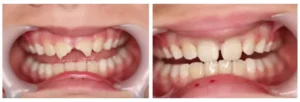
An 8 year old girl broke her two front teeth in July 2013 as a result of a fall. Her parents retrieved the broken fragments and contacted my surgery immediately for consultation. Fortunately the breaks were through the enamel and dentin only leaving the pulps intact. This removed the need for complex root canal treatment.
Local anesthetic was administered as the teeth were quite sensitive, rubber dam placed around the teeth and the fragments reattached giving the patient an excellent aesthetic result.
A 7 year old child presented with a decayed lower molar tooth. Mum was concerned as the patient was experiencing severe sensitivity and could not eat on the tooth. After the teeth were examined it was established that the tooth was not decayed but hypomineralised. The condition is known as Molar Incisor Hypomineralisation or (MIH). As the name suggests, this condition can affect the molars (the back teeth) and, or the incisors (the front teeth). It most commonly affects the Molars and more commonly the first permanent molar teeth, which appear in the mouth typically between 5 and 7 years of age.
Hypomineralisation means that the enamel or the tough outer layer of the tooth is hypo or under mineralised, which essentially means not properly formed and is in fact quite soft. Local anesthetic was administered because of the sensitivity, the rubber dam placed and the soft enamel was removed . The tooth restored and fissure sealed. There was in fact no tooth decay present. At review the sensitivity had resolved and the patient was eating comfortably on the tooth. This intervention has dramatically reduced the risk of tooth decay.